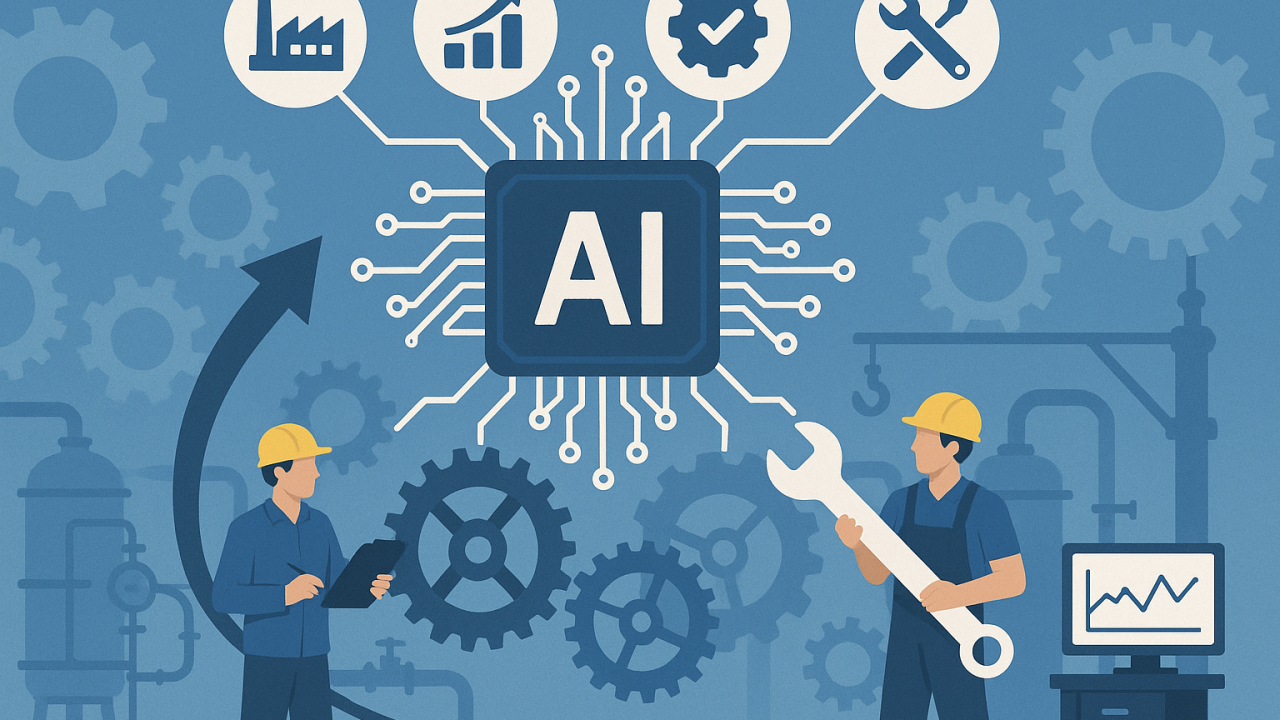
AI won’t replace maintenance people – but maintenance people using AI will replace those who don’t.

Richard Jeffers
I'm getting old! I've been in and around the world of maintenance for 33 years now, and have been majoring on the digitisation of maintenance for the last 8.
Through those years, I've been fortunate to have a lot of people I've been able to learn my craft from. Some were highly respected maintenance thought leaders, some great people managers, some skilled reliability engineers and others dedicated craftspeople solving problems out there on the shopfloor or down in the mud. I learnt about the importance of judging an asset's suitability for a task by seeing the distruction of a road trailor when towed at speed cross country behind a high-mobility vehicle and I learnt the importance of structured problem solving by seeing it's long term impact on the availability and reliability of a 20+ year old high speed can line.
Throughout my career, I think I've learnt a number of truisms:
- Engineers, and especially maintenance engineers, like machines; they especially like machines that run smoothly and efficiently.
- Engineers like to understand what's going on behind the scenes, or under the bonnet. They want to take things to pieces so they can understand how they work and how they can improove them.
- Whilst the operations and maintenance manuals might not be the first port of call for an engineer in the field, they all appreciate the value of a well presented, and well indexed O&M manual - sadly for industry, Haynes Repair and Workshop Manuals set the gold standard that few OEMs consistently meet.
- Maintenance engineers love a trend line, they like to see things running inside limits and, if it's trending off limits, they like to mentally forecast the tend and predict what will happen in the future.
Over the 8 years I've been focusing on the digitisation of maintenance, I've seen a lot of compelling concepts on how digitisation can support maintenance, and an increasing number of solutions that can deliver against these compelling concepts. I was recently researching some solutions for a client, and the range of promises from solution providers is awe-inspiring:
- Maintenance History Data: “Turn your past failures into tomorrow’s foresight.”, “Your maintenance notes have stories to tell — we let AI read them.”
- Condition Monitoring & Sensor Data: “See failure coming — and stop it in its tracks.”, “AI that listens to your machines, 24/7.”
- Inspection & Visual Data: “Let AI see what you miss — before it fails.”, “From eyes to insight: visual data meets machine vision.”
- Spare Parts & Inventory Data: “AI that predicts demand, prevents stockouts, and reduces waste.”, “AI starts with knowing what’s in your plant — down to the last bolt.”
Viewing the world of maintenance, and the available technology platforms to support that world in late 2025, it's easy to be overwhelmed with choice and default to one of two positions, both of which, in my view, miss the point:
- View 1: Techology as a silver bullet — believing the right platform alone will transform maintenance.
- View 2: Techology as a distraction — ignoring digital until “maturity” is reached.
I take a different view, I believe that technology can act as a major accelerator at every stage in the maintenance maturity journey, but only in the hands of a skilled practitioner who understands the basics intimately. An analogy is the increasing use of digital technology in navigation at sea. I'm a volunteer skipper on a sail training vessel and make extensive use of digital tools to ensure safe passage making. Be it charts, weather, tides, or collision avoidance, I use all the available tools - which includes paper back ups and sense checking the old fashined ways. Digital acceleration in maintenance is the same, and digital tools can be used at every stage of the journey.
1. Reactive Maintenance – Breakdown Culture: Firefighting, little data, no planning discipline.
- Basic CMMS / EAM: Record breakdowns, track costs, capture history with Mobile Work Orders / QR Codes to make reporting faster.
- GenAI assistants for fault logging: Auto-summarise technician notes into CMMS.
- Simple dashboards: Visualise MTTR, downtime trends.
2. Preventive Maintenance – Planned Chaos: PM checklists, but over-/under-maintaining.
- CMMS PM scheduling with usage counters (meter-based PMs).
- GenAI document extraction: Digitise OEM manuals, generate PM task lists.
- Workflow automation: Auto-issue PM work orders, calendar integration.
- Predictive analytics “lite”: AI suggests missing PMs or flags duplications.
- Chatbot front-end: Search PM tasks, standards, or spare part data.
3. Predictive Maintenance – Stability Starts: First use of data, condition monitoring (vibration, thermography, oil).
- IoT sensors & Predictive Maintenance (PdM) platforms: Continuous vibration, thermography, oil quality.
- AI anomaly detection: ML models flag deviations from baseline patterns.
- LLMs for PdM reports: Auto-generate inspection/condition reports for technicians.
- Spare parts forecasting models: AI predicts demand based on wear patterns.
- Digital twins (basic): Asset health models aligned with condition data.
4. Proactive Maintenance – Reliability Culture Emerging: RCM, RCA, defect elimination, planning & scheduling integrated.
- GenAI-accelerated RCM studies: Draft FMEA/RCM tables from manuals & histories.
- AI root cause analysis (RCA): NLP mines unstructured failure reports for patterns.
- Planning optimisation: AI balances schedules, predicts job durations.
- Spare parts optimisation: ML-based stocking strategies (min/max, EOQ).
- CM chatbots: Conversational AI for operators/maintainers to query past failures, RCA, or spare parts instantly.
- Precision maintenance AI tools: Alignment, lubrication optimisation, balance analysis.
5. Culture of Reliability – People-Centric Excellence: Reliability embedded in business strategy, ISO 55000 aligned.
- Enterprise Asset Intelligence: AI integrates financials, operations, maintenance, risk.
- Autonomous agents for maintenance strategy: Scenario planning (cost vs risk vs uptime).
- Digital twins (full-plant): AI-driven simulations of asset life-cycle.
- GenAI policy co-pilot: Drafts ISO 55000 aligned documents, audit evidence packs.
- Knowledge AI: Institution-wide memory that preserves tacit knowledge (expertise capture from retirees).
- Closed-loop optimisation: AI links reliability, sustainability, and business KPIs.ty at a reduced cost, regardless of where you are on the maturity journey.
- View 2: Technology is a distraction from the hard yards of increasing maintenance maturity through tried and tested techniques, and should only be considered when you have reached high maturity.
I take a different view, I believe that technology can act as a major accelerator at every stage in the maintenance maturity journey, but only in the hands of a skilled practitioner who understands the basics intimately. An analogy is the increasing use of digital technology in navigation at sea. I'm a volunteer skipper on a sail training vessel and make extensive use of digital tools to ensure safe passage making. Be it charts, weather, tides, or collision avoidance, I use all the available tools - which includes paper back ups and sense checking the old fashined ways. Digital acceleration in maintenance is the same, and digital tools can be used at every stage of the journey.
1. Reactive Maintenance – Breakdown Culture: Firefighting, little data, no planning discipline.
- Basic CMMS / EAM: Record breakdowns, track costs, capture history with Mobile Work Orders / QR Codes to make reporting faster.
- GenAI assistants for fault logging: Auto-summarise technician notes into CMMS.
- Simple dashboards: Visualise MTTR, downtime trends.
2. Preventive Maintenance – Planned Chaos: PM checklists, but over-/under-maintaining.
- CMMS PM scheduling with usage counters (meter-based PMs).
- GenAI document extraction: Digitise OEM manuals, generate PM task lists.
- Workflow automation: Auto-issue PM work orders, calendar integration.
- Predictive analytics “lite”: AI suggests missing PMs or flags duplications.
- Chatbot front-end: Search PM tasks, standards, or spare part data.
3. Predictive Maintenance – Stability Starts: First use of data, condition monitoring (vibration, thermography, oil).
- IoT sensors & Predictive Maintenance (PdM) platforms: Continuous vibration, thermography, oil quality.
- AI anomaly detection: ML models flag deviations from baseline patterns.
- LLMs for PdM reports: Auto-generate inspection/condition reports for technicians.
- Spare parts forecasting models: AI predicts demand based on wear patterns.
- Digital twins (basic): Asset health models aligned with condition data.
4. Proactive Maintenance – Reliability Culture Emerging: RCM, RCA, defect elimination, planning & scheduling integrated.
- GenAI-accelerated RCM studies: Draft FMEA/RCM tables from manuals & histories.
- AI root cause analysis (RCA): NLP mines unstructured failure reports for patterns.
- Planning optimisation: AI balances schedules, predicts job durations.
- Spare parts optimisation: ML-based stocking strategies (min/max, EOQ).
- CM chatbots: Conversational AI for operators/maintainers to query past failures, RCA, or spare parts instantly.
- Precision maintenance AI tools: Alignment, lubrication optimisation, balance analysis.
5. Culture of Reliability – People-Centric Excellence: Reliability embedded in business strategy, ISO 55000 aligned.
- Enterprise Asset Intelligence: AI integrates financials, operations, maintenance, risk.
- Autonomous agents for maintenance strategy: Scenario planning (cost vs risk vs uptime).
- Digital twins (full-plant): AI-driven simulations of asset life-cycle.
- GenAI policy co-pilot: Drafts ISO 55000 aligned documents, audit evidence packs.
- Knowledge AI: Institution-wide memory that preserves tacit knowledge (expertise capture from retirees).
- Closed-loop optimisation: AI links reliability, sustainability, and business KPIs.
Closing Summary & Call to Action
The fundamentals of maintenance haven’t changed in 50 years — assets still need to be understood, cared for, and restored when they fail. What has changed is the toolbox available to us. AI isn’t a replacement for skilled engineers; it’s an amplifier. It helps us capture knowledge, spot patterns we’d otherwise miss, and make faster, better-informed decisions.
The winners won’t be those who chase every shiny new technology, nor those who ignore it until it’s “safe.” They’ll be the practitioners who master the basics and then use AI as a force multiplier at every stage of their maturity journey.
So here’s the question: where are you on your maintenance maturity journey, and how are you using AI to accelerate the next step?
View Blog →