Santa’s Storeroom Crisis: How the North Pole Uncovered Millions in Obsolete Stock — and What It Means for Your Maintenance Strategy

Richard Jeffers
Every December, Santa’s Workshop becomes the most intense production environment on earth. Millions of toys, zero tolerance for breakdowns, and a go-live date that absolutely cannot slip. So when I visited the North Pole this year, I expected to find the usual combination of festive chaos and engineering brilliance. What I didn’t expect was a crisis unfolding quietly behind the scenes — not in the sleigh bay, not in reindeer operations, but in the one place that looks identical in every factory I’ve ever worked in: the spare parts storeroom!
Monica — Santa’s Chief Elfineer and long-standing ambassador for maintenance maturity in the Arctic Circle — greeted me with a look I’ve seen many times. Equal parts disbelief, resignation, and “you’re not going to believe this”. “Richard,” she said, “I think we’ve found a problem. And by ‘problem,’ I mean several million North Pole Pounds of frozen capital.”
🎁 The Discovery: A Storeroom Full of Christmas Past
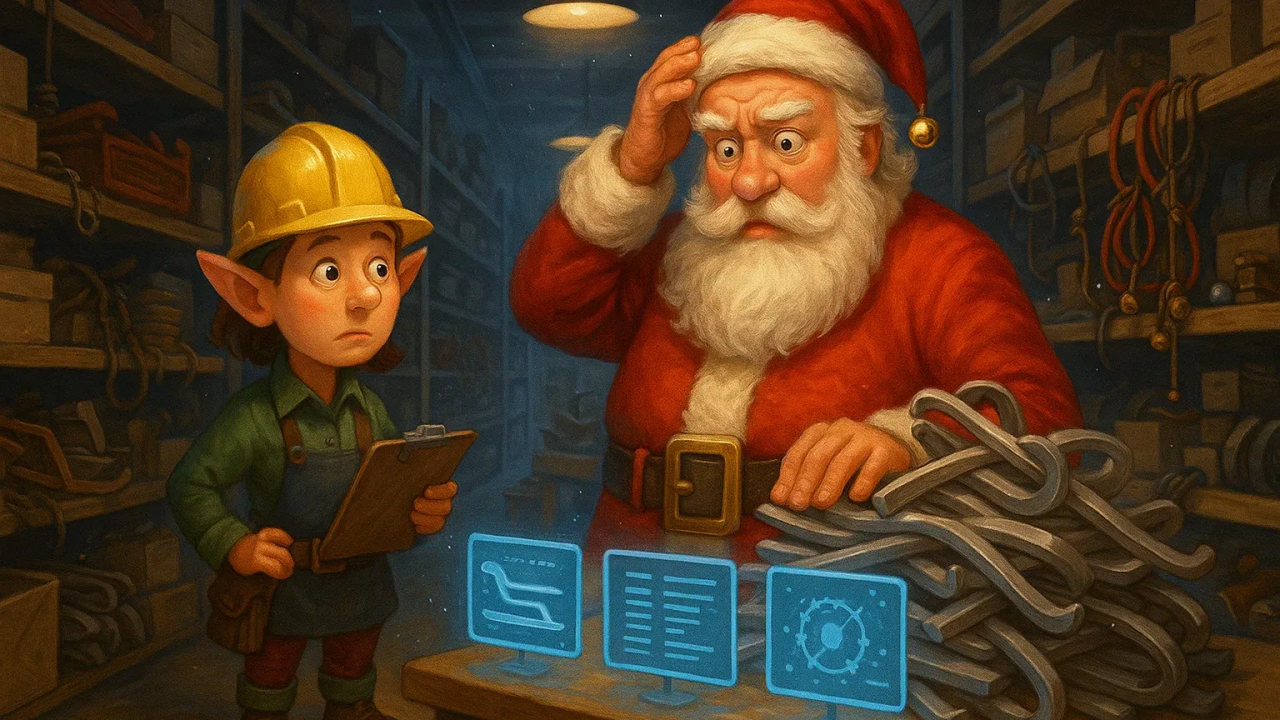
It started innocently enough. The elves were conducting the annual full stock count when they noticed entire aisles that hadn’t been touched since the Y2K scare. Dust on boxes and parts wrapped in materials no elf could identify. There were:
- Sleigh runner assemblies for sleigh models retired in 1874
- Gearboxes for toy-making machines replaced three generations of elves ago
- Enough obsolete reindeer telemetry sensors to track every animal in Scandinavia
- Hundreds of unidentified parts affectionately labelled “Just in Case (Probably Important)”
If you work in engineering, you already know this story. The only surprising thing is that it took this long for Santa’s team to open the cupboard.
🧝 The Root Cause: A Culture of Christmas Hoarding
Santa’s operation has always been reliability-first, but even the most magical organisations fall into familiar traps:
Fear of downtime → over-stocking Fear of stockouts → duplicating orders Fear of audit findings → keeping everything “just in case”
No one intended to build a museum of industrial archaeology; it just happened — one well-meaning replenishment request at a time.
Monica took me to a shelf where three boxes sat side by side:
- “Reindeer Harness Coupler v2”
- “Coupler, Harness, R. Team, Rev B”
- “Coupler—Main Sleigh Pull Assembly (Legacy)”
Three SKUs. Three descriptions. One part.
💸 The Financial Shock: When Christmas Spirit Meets Carrying Cost
Once the elves added up the slow-movers, the no-movers, and the parts-for-assets-that-no-longer-exist, the number was staggering.
The North Pole was spending the equivalent of 15–25% of its inventory value each year in silent overhead:
- Lighting, heating, and maintaining aisles of obsolete stock
- Counting, recounting and moving parts no elf had ever requested
- Holding capital that could have funded a major workshop upgrade
- Wasting elf-hours searching for parts that should exist
- Purchasing items already sitting hidden in the “snowdrift aisles”
Even Santa raised an eyebrow — a rare occurrence, normally reserved for behaviour on the Naughty List. “This,” he said, “isn't very… festive.”
🧠 Where the Crisis Turned Around: Intelligent Cross-Referencing
Enter the new AI-powered North Pole Inventory Initiative, led by Monica and supported by a small but suspiciously bright elf named Cyril. Cyril fed the entire inventory — descriptions, suppliers, legacy item data, BOMs, and even scanned handwritten labels — into an AI model trained explicitly for industrial spare parts.
Within seconds, the system began mapping:
- Duplicates across centuries of naming conventions
- Equivalents and alternatives long forgotten
- Obsolete stock tied to retired assets
- Stock levels wildly exceeding any realistic consumption
- Opportunities to consolidate supplier catalogues and reduce acquisition cost
The elves stared at the screen as clusters formed. Boxes merged. Whole shelves disappeared from the virtual store.
“Richard,” Monica whispered, “we’ve been stocking eight versions of the same sleigh stabiliser bracket for 60 years.”
Having seen similar situations repeatedly across manufacturing sites, I reassured her: “Honestly, that’s pretty good. Most factories run at twelve.”
🔧 The Engineering Lesson: Stocking Decisions Must Start with Reliability
The real breakthrough came when the elves linked inventory to their maintenance and RCM insights. Suddenly, stocking decisions had logic again:
- Critical sleigh components → Stock and monitor
- High-frequency wear parts → Runners with tight supplier integration
- Rare but essential parts → Limited stock, long-term supplier agreements
- Non-critical, easily sourced items → No shelf space required
- Obsolete components → Immediate disposal
- Everything else → Classified as runners, repeaters, or strangers
This wasn't just house-keeping. It rewired how maintenance thought about risk, cost, and uptime.
As Santa put it: “If it doesn’t help us deliver gifts, why are we funding it?”
🧩 The Cultural Shift: From Hoarding to Confidence
The greatest change wasn’t in the CMMS. Or the dashboards. Or the neatly labelled shelves. It was the mindset. Santa’s team moved
From: ❄️ “Order another one just in case” to 🎄 “Let’s see if we already have it, or whether an equivalent exists”
From: ❄️ “Keep everything — it’s safer” to 🎄 “Stock what matters — the data tells us what’s critical”
From: ❄️ “The storeroom is a safety blanket” to 🎄 “The storeroom is a strategic asset”
And with AI cleaning the data, linking equivalents, and predicting future demand, the elves actually trusted the system — perhaps the biggest miracle of Christmas.
🎅 The Outcome: Christmas Saved (Again)
With the storeroom optimised, obsolete stock removed, critical parts secured, and predictable demand on the horizon, the benefits were immediate:
- Millions of North Pole Pounds released from inventory
- Fewer emergency “midnight-sleigh” purchases
- Faster identification during maintenance and AM checks
- Higher reliability of the sleigh and workshop assets
- Better planning across production peaks
- A calmer Monica — which the elves now list as a leading KPI
Santa summarised it perfectly: “Magic is wonderful, but good engineering is what gets the job done.”
🎁 Closing Thought
Santa’s Storeroom Crisis is a reminder that no organisation — not even one powered by Christmas spirit — is immune to poor data, obsolete stock, and well-intentioned hoarding.
But with the right mix of AI cross-referencing, reliability-led stocking decisions, and a cultural shift away from ‘just in case’ thinking, even the dustiest shelves can be transformed into insight, working capital, and resilience.
If Santa can modernise his spare parts strategy, so can the rest of us.
Happy holidays — and may your storeroom be as tidy, intelligent, and financially healthy as the North Pole’s newly renovated version. 🎄✨
View Blog →